Silence.
The complete and utter absence of sound and noise, an abyss of stillness and emptiness. Last week I wrote about music and it’s significant presence and role in my life and in life in general. Today, I will talk about what is almost the exact opposite of that. Silence is hard to come by and with a small amount of effort you can avoid silence completely for days, months and even years at a time. It is hard to detect silence as it cannot necessarily be heard. Silence is by definition the absence of sound after all. But also with little effort (unless you live next to a highway) silence is easy to come by, even if it may not be utter. In this article I am going to talk about the essence of silence and the therapeutic benefits we can reap from embracing it.
Meditation is an ancient eastern practice of focusing on a specific thought, and while in that state of focus, shunning all other thoughts. It requires silence to practice, but for experienced meditators, it can be carried out in the middle of a noisy bus or in a crowded street. Now even though the beginning of practicing meditation is about external silence and internal focus. Eventually, meditation is about inner silence and peace extending into the outside world. For beginners in meditation it is important to sit in complete silence for large periods of time, simply to be able to clear one’s mind and to focus on a specific thought, like breathing or the visual image of a peaceful beach front.
Meditation is also associated with numbing the sense of physical sight. I say physical sight because in some cases of meditation, it is encouraged to open the inner eye or the conceptual eye to be able to visualize and imagine certain peaceful and centering scenarios. Silence and meditation go hand in hand and with complete silence peace is drawn from the emptiness there in. Seemingly your mind draws peace and stillness from this abundance of silence. A true paradox, if I ever heard one.
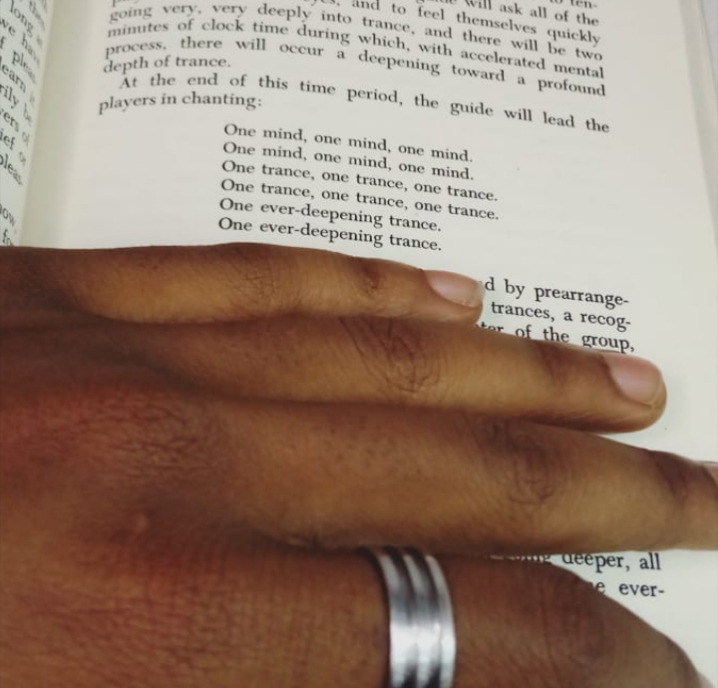
I once read a psychology book called mind games, it was a really old book I picked up at the Kenya institute of business and counselling library. It detailed an approach to meditation and therapy that seemed wildly unorthodox to me. It seemed like a weird drug induced utopia of borderline unethical psychology. In this book, mind games were described as something along the lines of being able to visualize in great detail certain conceptual scenes and places. In this book, case studies of these methods were described. A group of people would sit in silence for extended periods of time and while they were at a certain stage in meditation they would be suggested upon scenes and placed to meditate about. They would then be led to fall into a deep trance of meditation where they could experience a large number of scenarios and experiences in an alternate timeline which moved considerably slower that normal time. When the facilitator of this therapy pulled them out of this trance the participants would often be shocked by how little time had actually passed, in comparison to all the time that had passed in their meditative states. They had seemingly slowed down time through deep trance-like meditation. I have documented this paraphrased excerpt to simply highlight the implications of silence as a tool of inducing peace, calm and relaxation while also potentially having psychoanalytic implications.
But silence also takes different forms and conveys different meanings, it can be an indicator of peace, tension, affection among a lot of other things. Silence is good, it helps to point out the things that are around us or within us, the things that give strength to who we are and to how we are to one another. Silence even in being a lack of sound or noise still can be used as a tool to convey, even though it is in a most unorthodox way.
 Aesthetic Ian